
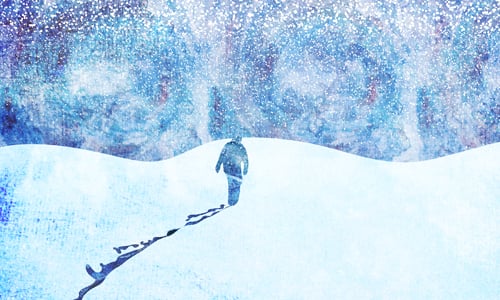
With much of the East Coast under blizzard warnings, the children are thrilled; the parents a little less so... In any case, this is an excellent opportunity to discuss snow in Judaism.
Snow in the Bible
Snow is mentioned several times in the Bible, as a metaphor or as part of a visual description.
Isaiah the Prophet said: “Though your sins be [as red] as scarlet, they shall be white as snow.”1 Scarlet symbolizes sin. No matter how low we fall, our deeds will one day become as white as snow, promises G‑d.
Isaiah speaks about the snow in other prophecies as well, saying, “As the rain comes down, and the snow from Heaven, and it will never return to there,” so, too, the words of the Creator “will not return to Me without having accomplished what I want them to.” 2
The famous ode “A Woman of Valor” contains the phrase, “She is not afraid of the effects of snow on her household; for all her household are clothed with scarlet.”3 The simplest way to understand the sentence is to see it as the praise of a hardworking woman who makes sure that the members of her household won’t be cold.4 The Midrash explains that the reference to snow here is a metaphor for the chilling punishment in the afterlife, something the righteous woman has no need to fear.5
The Book of Psalms mentions snow when it describes the goodness that the Creator bestows upon the world.6
The Talmudic sage Rava says that snow is five times better than water for the grass and shrubs that grow wild on the mountains, presumably because the rain runs off the mountain before it’s absorbed, while the snow piles up and soaks the ground as it melts.7
The Story of Hillel
The Talmud tells the following story:8
Hillel, a very poor yet pious man, earned only one coin a day. He was so devoted to Torah study that he spent half his earnings on food and half on paying for his admission to the study hall. One freezing winter day, Hillel couldn’t find work and didn’t even have half a coin for admission.
Hillel didn’t give up. He climbed to the roof of the study hall and found that by positioning himself above the skylight, he could hear the conversation of the sages Shmaya and Avtalyon, who were discussing Torah subjects. Snow began to fall, and it covered Hillel’s body. He fell unconscious and almost froze to death.
The next morning, the sages noticed that it was dark in the room. By the time they discovered Hillel’s body blocking the opening, it was almost too late. Three cubits (nearly five feet) of snow had piled up on top of Hillel! It was Shabbat, but saving a life takes priority; they warmed him and treated him as needed. Hillel became one of the greatest Torah scholars of all times, and his many legal decisions have been recorded in the Mishnah.
Snow in Halachah
On the one hand, snow is made of water, a liquid. On the other hand, it’s a solid. This makes for interesting complications in legal literature.
Washing hands with snow
Hands must be washed in the morning before you can say blessings and pray. There are those who are of the opinion that you can fulfill this halachic obligation by immersing your hands in snow, and indeed, the Shulchan Aruch Harav originally rules that when there is no water, one can use unmelted snow.9
However, the Alter Rebbe ultimately rules in his siddur that even in such a situation, one cannot use unmelted snow; instead, one needs to melt the snow and then use the water to wash his or her hands.10
Mikvah
A mikvah may only be filled with water that has never been placed in a vessel. If there is no rain available, the mikvah can be filled with snow that is transported in a specific manner, and it will be fully kosher once the snow melts.11
Shabbat
Snow on Shabbat raises several practical halachic questions. Freshly fallen snow may involve issues of muktzah or possibly nolad (something newly created on Shabbat), though many authorities permit handling it under normal circumstances. Walking on snow is generally permitted, even though it compresses or leaves footprints. However, making snowballs or building a snowman can raise concerns of boneh (constructing) or makeh b’patish (completing an item).
Shoveling snow may also present issues—particularly if one is clearing it for convenience rather than safety. Melting snow intentionally (for example, bringing it inside to liquefy) can raise additional halachic questions. And, of course, in areas without an eruv, carrying snow or snow-covered objects outdoors would be prohibited like any other carrying.
For a fuller discussion of these issues see: What You Need to Know About Snow on Shabbat
The Lesson of Snow
What is snow? Something temporary. It began as water, and will eventually become water again. Chassidic philosophy draws a parallel to Torah.
At the outset, the Torah is a heavenly and spiritual delight, like water, “from which all pleasurable things grow.” In the end, after the person learns and understands the Torah, it is also a great delight. But often during the journey, the subject matter of the Torah may seem simple and mundane, hard and cold like the snow.
However, just like snow is essentially water and will eventually return to its original state, by grasping the Torah’s physical “snowy” form, you have grasped the essence of the Torah, and will ultimately experience its spiritual “watery” state.12



Start a Discussion